
Recap Video @ SFU Surrey’s Open House 2015. Filmed and Edited by Solomon Hsu
The Twitter Powered Vending Machine works by a user “Tweeting” a specified #HashTag as displayed on the screen along with a secret code, doing so unlocks and activates the machine. The Secret Code which changes after every use is to ensure that a user is physically in-front of the machine and prevents someone from simply tweeting the specified #HashTag when they aren’t there.
For
School Project (Evolved)
Type
UX, Physical Product
Date
2014 - 2016
Role
Project Management, Programming, Motion Graphics/Animations
Team
Bruce Beh, Josh Cheng, Amanda Poh
Software/Tools Used
Processing, Arduino, After Effects, Illustrator
The purpose of the Twitter Powered Vending Machine is to use social media engagement as a currency rather than simply asking the user for money as we know today. This allows the user to “pay” by becoming engaged through the use of social media, receive a tangible item and ultimately, sharing this engagement experience and tangible item with others. This not only boosts social media engagement, product and brand recognition, but also increases the product and brand loyalty when the user shares their experience with others (or when others see this users' engagement within social media channels).
Note: This section focuses on the physical construction and design of the dispensing mechanism.
We looked at how vending machines currently worked, what made them attractive (or unattractive), and what we could do to improve upon it. Meanwhile we also examined how other in-market Twitter Powered Vending Machines worked drawing inspiration and evaluation. Ultimately, we found that a display screen along with an informative animation loop would attract attention much more attention to our machine compared to its competitors. The animated display screen also provides dynamic instructions which allows a potential user to interact with the machine without any additional third-party intervention. In addition, we also designed the machine to be smaller sized for the purposes of convenience and portability as the machine would often be transported to various events.
During the design process of our machine we went through various phases which primarily involved modifying and re-building the dispensing mechanism. As the machine was initially created as part of a second-year course, we had limited access to materials and fabrication tools. This meant we had to be creative in how we came up with the dispensing mechanism. Throughout the entire process we were challenged with creating our own dispensing mechanism rather than using what was available off the shelf. Within the various phases we also completed aesthetic and design changes that would improve the overall user experience of the machine.
We were challenged with creating our own dispensing mechanism rather than using what was available off the shelf.
The first phase of our project was started during a class called “Introduction to Technological Systems”. The objective was to create a machine that would allows the user to select between two different kinds of candy with the use of a slider sensor (Left for Candy A and Right for Candy B). The mechanism created was done using simple household materials. The main concept is that there is a hole cut out on a foam core disc. A servo motor would rotate the disc to match the cut-out hole to the end of the funnel and stay there for a pre-determined period of time (3 seconds).
Although this mechanism satisfied our specified requirements, we discovered a few issues with it:
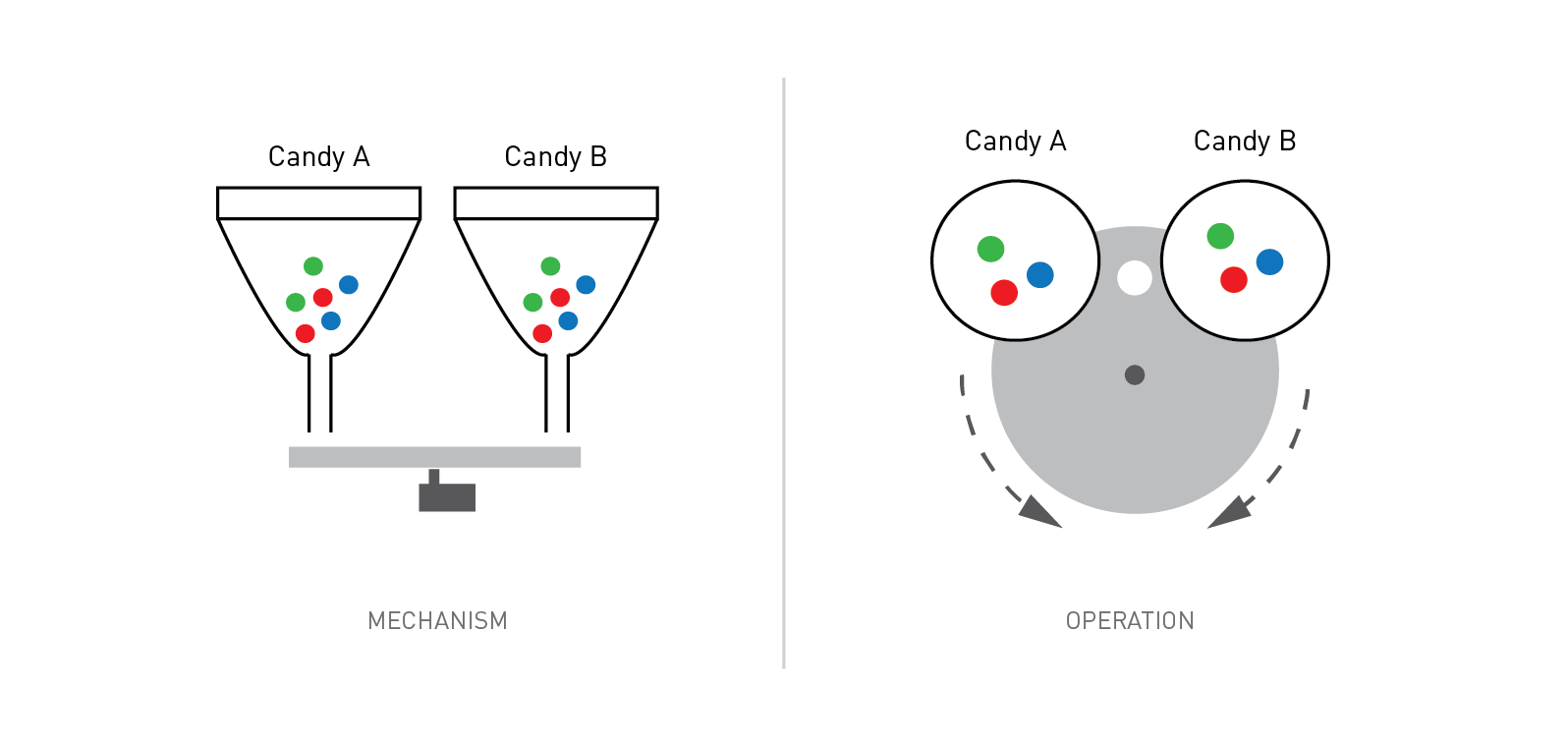
Foam core disc mounted on a motor that rotates left or with based on the selection of candy.
Phase Two began when our project was required to dispense packaged candy instead of unpackaged for sanitary reasons. We worked on resolving all the issues we had discovered during the first phase. This included rebuilding a new dispensing mechanism that consisted of a tall rectangular chamber and a swinging arm mounted onto a servo motor. The main concept is that the product being dispensed would be stacked on top of each other within the chamber. An arm mounted to the servo motor would swing around and push the product out of the chamber. As we had to use a continuous rotation servo, an infrared sensor was added so we could determine when the arm had completed a full swing.
While this phase resolved our main issue of allowing us to dispense packaged candy or other packaged products, there were a few limiting issues and challenges:
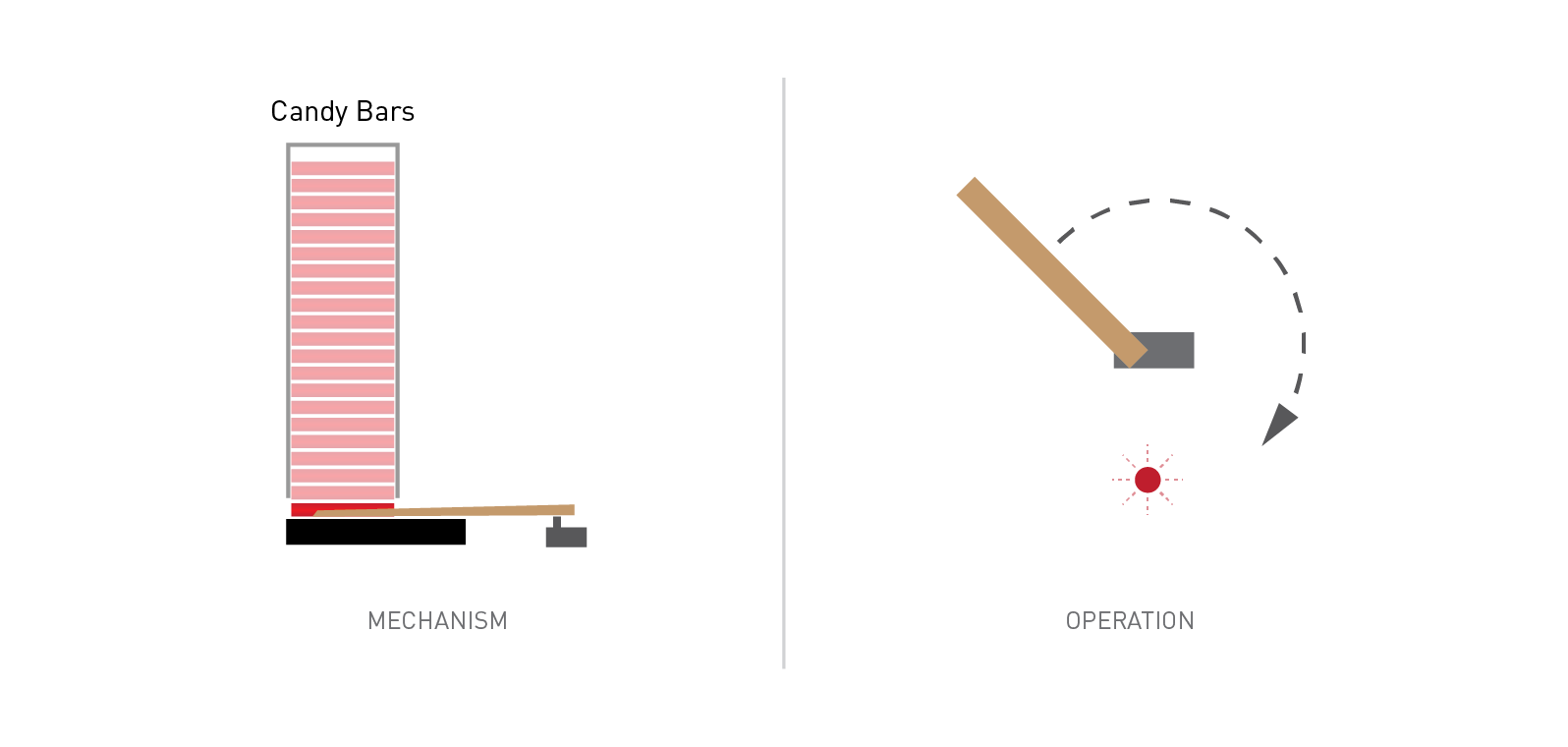
Candy Bars are stacked inside a chamber. Swinging arm mounted to the motor to pushes the product out. Infrared sensor determines when arm has completed a full rotation.
Phase Three of this project began when we were approached by a group that had wanted to use the machine for promotional purposes. We began this phase by attempting to solve the issues we had with our machine in the previous phase. This meant another iteration of our dispensing mechanism. However, as we were now designing the machine for the purpose of being used by someone else, we had to determine what was the best way to accomodate for a variety of usage case scenarios and account for having maximum flexibility in what was being dispensed and how it was being dispensed. Ultimately this led us to re-designing the machine reflective of actual users rather than ourselves.
This led us to re-designing the machine reflective of actual users rather than ourselves.
One of the major changes we completed was re-working the dispensing mechanism. We decided to make use of a mechanism that is often found in traditional vending machines: spiral rings. The benefit of using spiral rings allowed us to dispense products of various sizes, and also gave us the freedom to dispense multiple products within one machine (by using multiple spirals). The concept was to attach one end of the spiral ring to the motor. When the motor spins it would rotate the spiral pushing the product that we place in between the spirals forward. We also continued to make use of an infrared sensor to determine when a product would be dispensed and thus stopping the motor from rotating.
This resulted in 100% accuracy in dispensing products and allowed for a nearly unlimited option on the type of product being dispensed provided it fit within our machine.
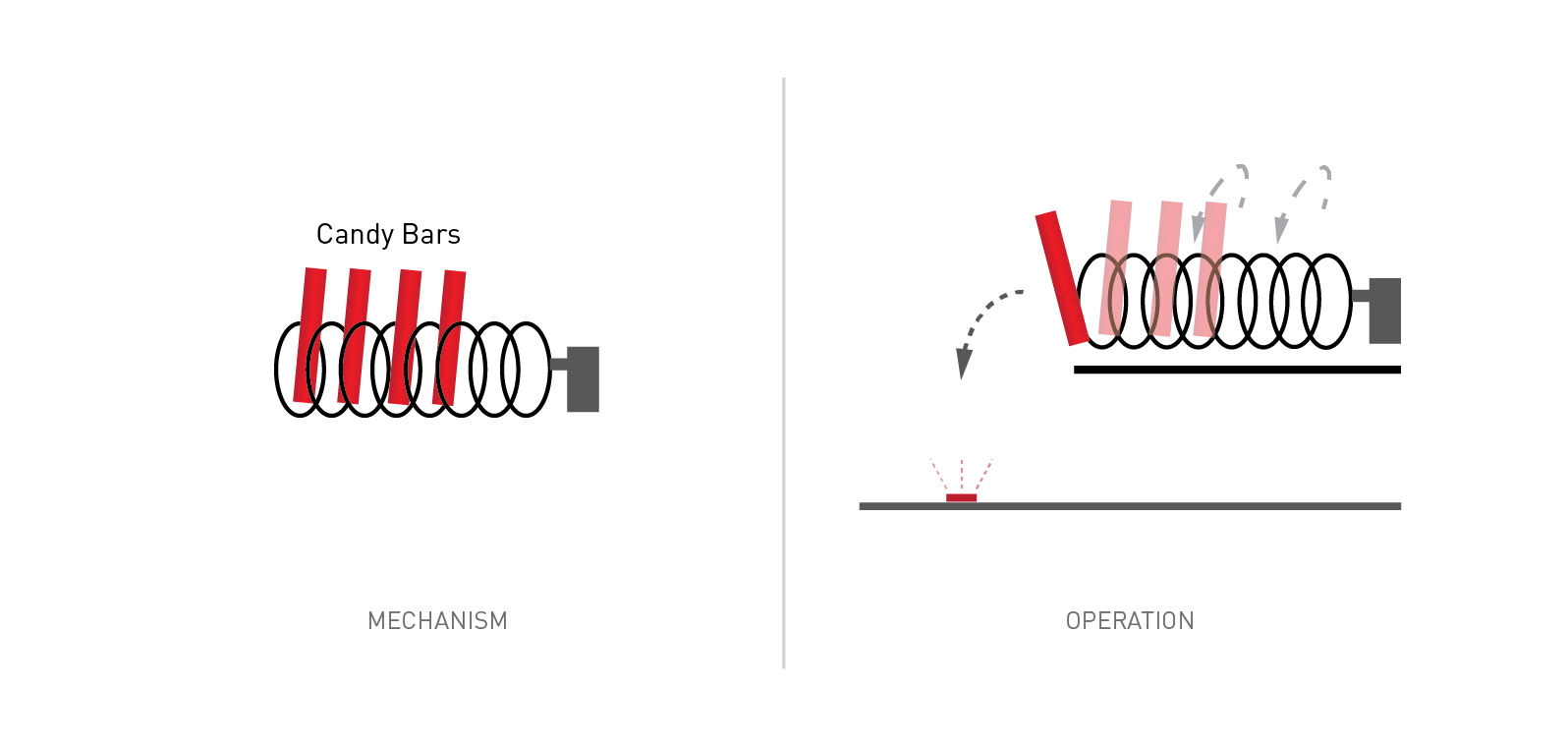
Spiral Rings are used to hold and push the product forward over a ledge. Infrared sensor is used to determine when product has fallen.
Although initially a school project. Phease three was so successful that after it was shown at SFU Surrey's 2015 Open House it was developed into a trial business that allowed organizations to rent the machine and use it for their own promotional events. The machine has been at 15 events, generating over 500,000 social media impressions and dispensed more than 3000 items.
What are you doing this weekend? We're back with #SFU50 at #SurreyFusion this Sat + Sun! http://t.co/UM326v4UkZ pic.twitter.com/l6AnjhNmgb
— Treat for Tweet (@TreatforTweet) July 17, 2015
Picture of the machine at one of many SFU's 50th Anniversary Celebration Events
Celebrating SFU's 50th Anniversary at Burnaby Heights Hat's Off Day. Video filmed and edited by Solomon Hsu